

Art therapy is a technique created around the idea that creative expression can promote healing and mental well-being. By either creating it or viewing others art, it is used to help people explore emotions, develop self-awareness, cope with stress, boost self-esteem, and work on social skills.
Art therapy can help children, adolescents, and adults! Also, great for managing addictions, anxiety, depression, and coping with a physical illness or disability.
Art therapy can include a wide range of art materials and processes. Your sessions could potentially include activities such as working with clay, painting, making a mask, creating a visual journal, and assembling a collage. Most often, the focus will be on the process rather than creating a finished art product.
How is art healing?
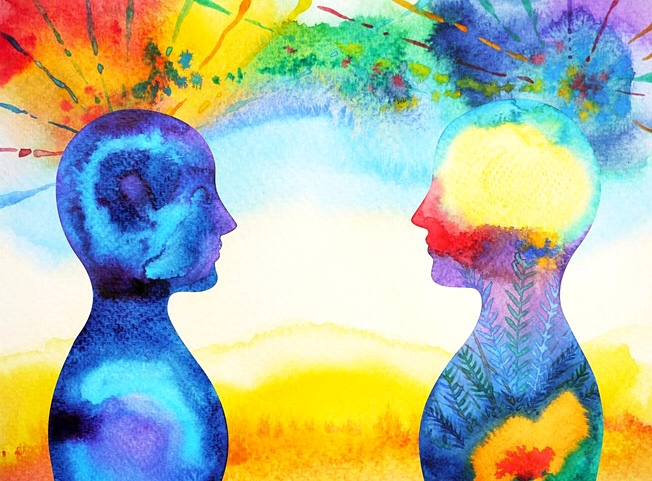
Art is healing because it forces you to forge a connection between your mind and your body. Unlike exercise, which works your body, or meditation, which clears your mind, art-making accesses both mind and body to promote healing.
Art Brings More Creativity, Satisfaction, and Happiness into our Lives. Scientific studies have proven that art appreciation improves our quality of life and makes us feel good. When we create art, we elevate our mood, we improve our ability to problem solve, and open our minds to new ideas.
How is art related to life?
Art surrounds life, all people in every location, without us being aware of it. Since time immemorial, art has existed as long as man has. It is a huge part of our culture, which shapes our ideas, and vice versa, and provides us with a deeper understanding of emotions, self-awareness, and more.
Who created art therapy?
The British artist Adrian Hill coined the term art therapy in 1942. Hill, recovering from tuberculosis in a sanatorium, discovered the therapeutic benefits of drawing and painting while convalescing.
Okay, but are you ready to get into something a little more dark? Regarding the topic, of course..
How about, Famous Artists Who Struggled with Mental Illness? After all, even those who we may look up to have their own struggles. How is that for not feeling alone? Let’s take a look!
• Vincent Van Gogh. – By far the most famous example of an artist with mental illness. Van Gogh suffered from anxiety and depression throughout his short life, and he once wrote, “I put my heart and my soul into my work, and lost my mind in the process.”
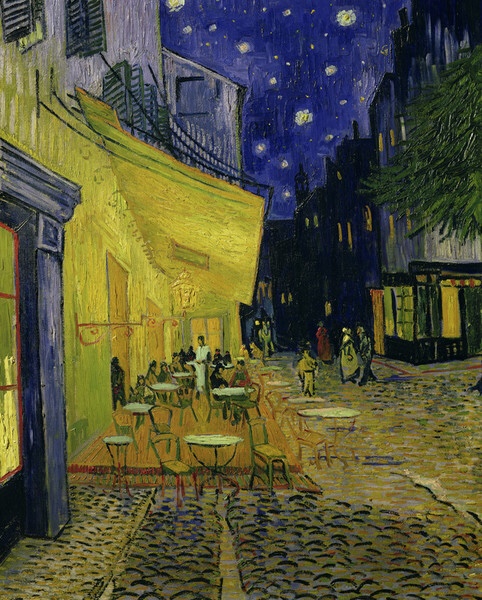
Vincent van Gogh was a Dutch post-Impressionist painter of landscapes, still life works, and self-portraits. He was not commercially successful during his lifetime, and his death at 37 from a self-inflicted gunshot came after years of mental illness, depression, and poverty. After his death, he became better known and he is now considered one of the most influential artists in the history of Western art. His work, with its bold brush strokes and colors, shows not only a tortured mind but also an immense talent.
• Edgar Degas – was known to be an old curmudgeon who hid away in his studio only to emerge at night to walk the streets of Paris. He visited salons with a small circle of fellow artists and patrons and bristled at any intrusions from art critics. In a grouchy tone, he once wrote to critics, “Is painting done to be looked at? Do you understand me? One works for two or three friends who are alive and for others who are dead or unknown.”
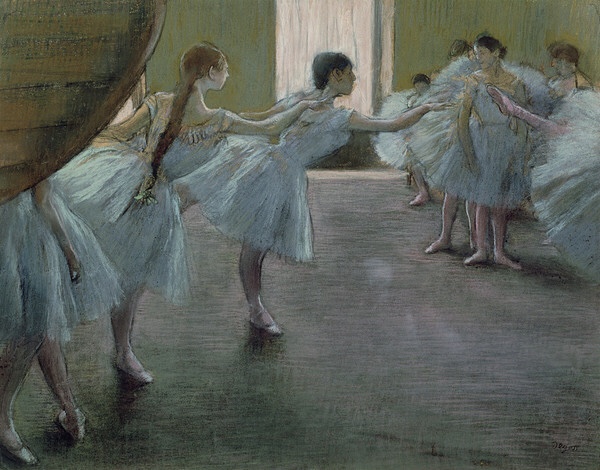
Degas was friends with American Impressionist painter Mary Cassatt, who also lived in Paris. Degas, Cassatt, and Cassatt’s sister, Lydia, were often seen at the Louvre studying artworks together. Cassatt and Degas weren’t romantically involved, and in fact, neither ever married. Degas lived alone his entire adult life.
In the 1880s, Degas suffered from bouts of depression and aimlessness. “I’m blocked, impotent. I’ve lost the thread,” he wrote in a letter in 1884. Degas spent the last years of his life nearly blind, restlessly wandering the streets of Paris. Although he had friends and family, his irritability and cruel sense of humor tended to chase people away. He died in 1917. Isn’t it amazing that such a grouchy man could have made such beautiful and light-hearted paintings of dancers, singers, and people enjoying themselves at the races?
• Edvard Munch – suffered from anxiety and hallucinations. The painter created his most famous image, The Scream, after it came to him when he was out for a walk at sunset on a fjord overlooking Oslo. He wrote that as the sun began to set, it suddenly turned the sky a blood red. “I stood there trembling with anxiety and I sensed an endless scream passing through nature.” The painting is thought to represent human anxiety in the modern world,which Munch experienced throughout his life.
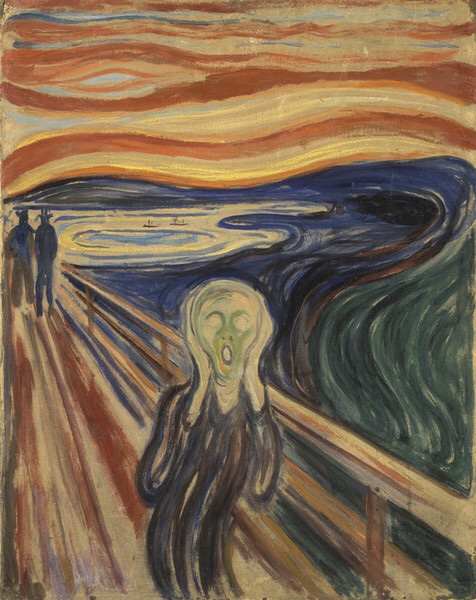
Mental illness ran in Munch’s family. His grandfather suffered from depression and his aunt was diagnosed with schizophrenia. Munch’s childhood was marked by loss, as his mother and one of his sisters died of tuberculosis, and one of his sisters was diagnosed with mental illness. In December 1889, after Munch’s father died, leaving the family destitute, Munch assumed financial responsibility for his family, though he was deeply saddened by the loss of his father.
In the autumn of 1908 his anxiety, compounded by heavy drinking, became acute, and he experienced hallucinations and feelings of persecution. He entered a clinic for treatment and after eight months emerged in better health. He saw his mental illness as an important motivation for his art. He wrote in his diary: “My fear of life is necessary to me, as is my illness. They are indistinguishable from me, and their destruction would destroy my art.” Munch died of natural causes in his house near Oslo on 23 January 1944, about a month after his 80th birthday. His artistic temperament and talent brought him success and eventually peace, and greatly benefitted the world of art.
• Mark Rothko – was an American abstract expressionist painter. Rothko was born in Latvia but grew up in Portland, Oregon and spent most of his adult life in New York City. He suffered from bouts of depression and was a heavy drinker. Viewing the vibrating colors in a large-scale Rothko painting in person at a museum is almost a mystical, meditative experience that should not be missed. Let’s hope that painting these works of art also brought the artist some peace and art therapy.
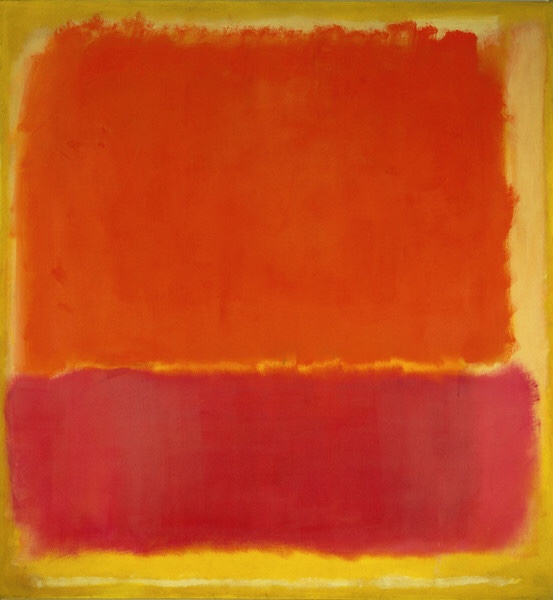
In early 1968, Rothko was diagnosed with a mild aortic aneurysm. He ignored his doctor’s orders and continued to drink and smoke, avoided exercise, and ate an unhealthy diet. His friend and art critic Dore Ashton said of him at the time that he was “highly nervous, thin, restless.”
On February 25, 1970, Rothko’s assistant found the artist in his kitchen, lying dead on the floor in front of the sink, covered in blood. He had overdosed on barbiturates, and cut an artery in his right arm with a razor blade. There was no suicide note. He was only 66. The tragedy of his suicide belies the joy that his colorful paintings elicit. He is considered one of the most influential modern abstract expressionists.
• Georgia O’Keeffe – suffered from depression, although it’s possible her depression was situational. She was admitted to Doctors Hospital in New York City for treatment after a nervous breakdown in 1933. Her two month hospitalization followed a difficult time in her life. She had just abandoned a project to complete a Radio City Music Hall mural, and her renowned photographer husband Alfred Stieglitz was having an affair with a woman almost two decades younger than O’Keeffe and more than four decades younger than himself.
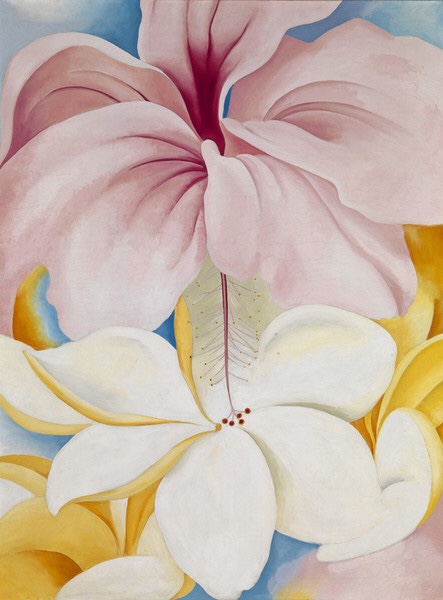
O’Keeffe had been invited to paint a mural in the women’s powder room at the new Radio City Music Hall. She agreed to the project despite minimal payment because she had long been intrigued by the challenge of painting a large work of art. Unfortunately, O’Keeffe discovered that the plaster of the new building wasn’t going to be dry in time, and she was unable to apply paint. She abandoned the project and became depressed. She became agoraphobic, stopped eating, and wept for days, according to one of her biographers.
O’Keeffe had visited New Mexico earlier and loved it. She returned in mid-1934 and recuperated from her hospital stay. In August she visited Ghost Ranch, north of Abiquiú, for the first time, and decided immediately to live there. She moved into a house on the ranch property in 1949. The warmth and beauty of Ghost Ranch seem to have helped her heal and they inspired some of her most famous landscape paintings. She lived to age 98.
• Michelangelo Buonarroti – Michelangelo’s hand was touched by genius and by madness. The paintings and sculptures of this artist rank among the best in the world, and a visit to Italy to see his work should be on everyone’s bucket list. He produced a huge volume of work with meticulous detail, leading some art historians to speculate that he had obsessive-compulsive disorder. He also suffered from depression and anxiety, shutting himself away from the world for days at a time to work, forgetting to eat or change clothes.
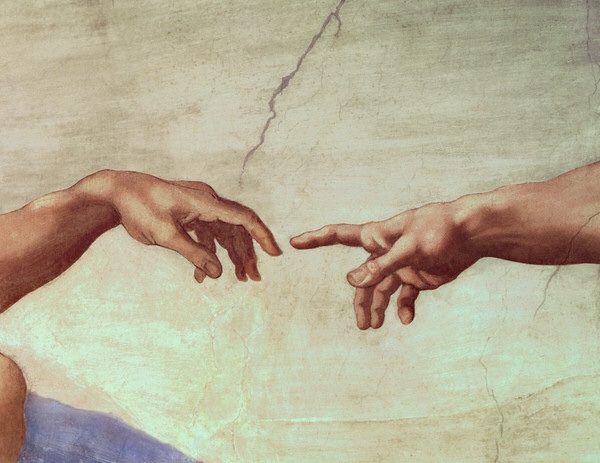
Michelangelo sculpted two of his best-known works, the Pietà and David, before he turned thirty. Although he held a low opinion of painting, he also painted two of the most influential frescoes in the history of Western art.
Much of his correspondence and notes have survived which means that his life and personality are well-documented. From his correspondence we know that he lived like a poor man, was indifferent to food and drink, and often slept in his clothes and boots. The earliest biography of Michelangelo, by Paolo Giovio (circa 1527), says Michelangelo’s nature “was so rough and uncouth that his domestic habits were incredibly squalid, and deprived posterity for any pupils who might have followed him.”
In one of his letters to his father, the artist wrote, “I lead a miserable existence and reck not of life nor honor – that is of this world; I live wearied by stupendous labors and beset by a thousand anxieties. And thus I lived for some fifteen years now and never an hour’s happiness have I had.”
As art fans, we can’t help but feel deep gratitude that Michelangelo and these other incredible artists persevered despite their illnesses to make beautiful and lasting works of art.
What do you think?
I find it very interesting that people with such talent, couldn’t see their own value enough to pull themselves through such darkness in their lives. But the same goes for anyone suffering from depression, anxiety, or any other mental health issue. We need to realize that we all have something special within ourselves that we may not be able to see, but it is there. Our own self value is so great. Never be afraid to speak up and get help. Never be ashamed to talk to someone who you trust. It’s human to go through obstacles in life. We all go through something that we may need a helping hand with. But we must understand that giving up is never an option. Break the silence, break the stigma.
I know that some of those artist stories ended in tragic events. But the emotions we feel as we read about them. It’s easy to feel and see that they were so much more than their illness. So much more than their negative emotions. We need to look at ourselves more like that. We are so much more than our struggles.
Here is a note from the article writer from the six artist we learned about today: “So many have struggled with mental illness and we want you to know that YOU ARE NOT ALONE.”
That is a strong message within only three lines. It is an acknowledgment that there is HOPE. People do care about YOU. You are LOVED. You are WORTH IT. 🖤;
For a crisis situation: •Call 1-800-273-TALK (8255) to reach a 24-hour crisis center, text MHA to 741741