

It’s time to talk about suicide prevention, warning signs,
and how to get help, or help someone else in need. It’s
important to understand suicide and what leads people to
such a vulnerable place. Let’s talk, let’s save lives!
Let’s start by understanding that suicide does not discriminate. No matter your age, gender, or ethnicities, you can be at risk. There is no single cause, as suicidal behavior is complex.
Many different factors can play a role in someone making a suicide attempt. But those most at risk do tend to share specific characteristics.
Here’s a list of the main risk factors for suicide:
– Depression, anxiety, substance abuse disorder, PTSD, or other mental disorders.
– Chronic pain.
– A prior suicide attempt.
– Certain medical conditions.
– Family history of a mental disorder or substance abuse.
– Family history of suicide.
– Family violence, including physical or sexual abuse.
– Having recently been released from prison, or jail.
– Having guns or other firearms in the home.
– Being exposed to others suicidal behavior, such as that of family members, peers, or celebrities.
Additionally, many people have some of these risk factors but do not attempt suicide. Keep in mind that it is important to understand that suicide is not a normal response to stress.
In fact, suicidal thoughts or actions are a sign of extreme distress, not a harmless bid for attention, and should never be ignored.
PLEASE, please, never think someone is only trying to get attention while displaying suicidal thoughts, actions, or even talking directly about attempting it. NEVER tell someone that they are just seeking attention. This could cost someone their life.
Additionally, a lot of the time someone with suicidal thoughts will not disclose that information to anyone. That is another reason why it is important to know the warning signs. Everyone reacts to this emotional state differently. It never means that one situation is more important than the other. Someone in crisis is exactly that, a crisis situation. They need help to overcome these emotions, rightfully so.
If you may be one who’s having warning signs or thoughts of suicide. Please seek help. You can overcome this. I have been there myself. I was at my end. I will admit. But looking back I can not imagine if I would have chose suicide instead of the help that I deep down knew that I needed. I am living proof that it is possible to seek help and recover. My story is far from easy, far from nice. It’s actually quite dark…
If anyone ever needs to talk, you can email me, directly! I would love to hear from you.
E-mail: selflove1013@yahoo.com
My name is, Jamie. And I do care about you!
That is my direct email specially made for chatting. And we can go from there.
Below I will also list the Lifeline National crisis hotline, which is totally confidential and free. I post a similar hotline on all of my blogs, which is also confidential and free.
I truly have honest passion for this and for all people. I want us all to beat this together and live the life we know that we are able to live. We are WORTH IT. We all have a beautiful journey of life awaiting us.
Often, family and friends are the first to recognize the warning signs of suicide. Whichs can be the first step toward helping an at-risk person find treatment with a specialist.
National Suicide Prevention Lifeline:
Call: 1-800-273- TALK (8255)
En Espanol 1-888-628-9454
The lifeline is a free, confidential crisis hotline that is available to everyone 24 hours a day, seven days a week. The Lifeline connects the caller to the nearest crisis center in the Lifeline National network. These centers provide crises counseling and mental health referrals.
People who are deaf, or hard of hearing: Contact the Lifeline via TTY at:
1-800-799-4889.
Crisis Text Line: (Available to everyone)
Text “HELLO” to 741741
This text hotline is also available 24 hours a day, seven days a week throughout the US.
The Crisis Text Line serves anyone, in any type of crisis, connecting them with a crisis counselor who can provide support and information.
Please, never be afraid to use these hotlines. I personally feel like it’s a comfortable approach over the phone or via text, if one may be nervous about an in person contact during a time so vulnerable.
Lets jump back in and talk about the Signs and Symptoms.
The behaviors below may be signs that someone is thinking about suicide.
– Talking about feeling empty, hopeless, or having no reason to live.
– Talking about wanting to die or wanting to kill themselves.
– Talking about great guilt or shame.
-Making plans or even looking for ways to kill themselves, such as searching for methods online, maybe even lethal methods. (pills, guns.)ect.
– Talking about feeling rapped or feeling that their is no solution to their situation.
– Feeling of unbearable pain. (emotional and/or physical)
– Using drugs or alcohol (even more often)
– Talking about feeling like being a burden to others.
– Acting anxious or agitated. (even irritable)
-Withdrawn from family and friends. (Anti-social)
-A change in sleeping and/or eating habits.
-Showing rage or maybe even talking about seeking revenge.
– Talking and/or thinking about death often.
-Taking great risks that could lead to death (such as driving excessively fast)
– Extreme mood swings, sudden changing from very sad to very calm or happy.
– Saying goodbye to friends and family.
– Giving away valuable, important, personal possessions.
-Putting affairs in order (making of a will)
If any of these warning signs apply, seek help. for either yourself, or others. Particularly if the behavior is new or increased lately.
Also, remember to pay attention to social media post. Sadly, I have seen it too many times lately. It’s almost like the new way to write a suicide note. Social media has turned into such a huge use to this generation.
I want to share a method with you that could be very helpful...
The 5 action steps for Helping Someone in Emotional Pain:
1. ASK – “Are you thinking about killing yourself?” It’s not an easy question, but studies show that asking at-risk individuals if they are suicidal does not increase suicides or suicidal thoughts.
2. KEEP THEM SAFE – Reducing a suicidal person’s access to highly lethal items or places is an important part of suicide prevention. While this is not always easy, asking if the at-risk person has a plan and removing or disabling the lethal means can make a difference.
3. BE THERE – Listen carefully and learn what the individual is thinking and feeling. Research suggests acknowledging and talking about suicide may reduce rather than increase suicidal thoughts.
4. HELP THEM CONNECT – Save the National Suicide Prevention Lifeline’s (1-800-273-TALK (8255) and the Crisis Text Line’s number (741741) in your phone, so it’s there when you need it. You can also help make a connection with a trusted individual like a family member, friend, spiritual advisor, or mental health professional.
5. STAY CONNECTED – Staying in touch after a crisis or after being discharged from care can make a difference. Studies have shown the number of suicide deaths goes down when someone follows up with the at-risk person.
Treatment options!
There are many great options out there for quality treatment.
Interventions: Safety Planning and Follow up phone calls.
– Safety planning has been shown to help reduce suicidal thoughts and actions, as well as develop a plan that describes ways to limit access to lethal means such as firearms, pills, or poisons. The plan also lists coping strategies and people and resources that can help in a crisis.
– Follow-up phone calls. Research has shown that when at-risk patients receive further screening, a safety plan intervention, and a series of supportive phone calls, their risk of suicide goes down.
Psychotherapies:
Multiple types of psycho-social interventions have found to help people who have attempted suicide. These types of interventions may prevent someone from making another attempt.
– Cognitive Behavioral Therapy (CBT) can help people learn new ways of dealing with stressful experiences through training. CBT helps people recognize their thought patterns and consider alternative actions when thoughts of suicide arise.
– Dialectical Behavior Therapy (DBT) has been shown to reduce suicidal behavior in adolescence. DBT has also been shown to reduce the rate of suicide in adults with borderline personality disorder, a mental illness characterized by an ongoing pattern of varying moods, self-image, and behavior that often results in impulsive actions and problems in relationships. A therapist trained in DBT helps a person recognize when his or her feelings or actions are disruptive or unhealthy, and teaches the skills needed to deal better with upsetting situations.
Medication:
Some people at risk for suicide might benefit from medication. Doctors and patients can work together to find the best medication, as well as the right dose. For people at risk for suicide that have both a mental illness and substance use problems, these people might benefit from medication along with psycho-social intervention.
I would never push medication on someone nor would I tell someone that it isn’t a good option when looking for treatment. The fact is, it will be different for everyone.
I remember trying a few different medications before I got the right one that worked with me. Before finding what was right for me, the medication actually made me feel worse. But any good doctor and therapist will work with you to make sure you find the quality care, the right options and medication for you. I mean at one point, early in my treatment I was misdiagnosed with bipolar disorder. When in fact I was suffering from PTSD. Which I do see how the two can be confused..they both are causes of terrible mood swings and aggressive behavior. But I finally found a medication recently that works amazing. It not only helps my PTSD, but it also works as one with my anxiety and depressive episodes. I have been on this medication for almost a year and though it took a few dosing adjustments, I haven’t have an aggressive episode or an anxiety attack in almost a year! It feels absolutely amazing, and to be honest, it feels like freedom!
I want to end this blog by saying that I am so happy that I got to get this one out for you all and I wish everyone the most positive vibes! I truly mean every word I say. And I truly care about each and everyone of you. Break the silence, break the stigma. Push forward, and NEVER give up on you!
Remember, In case of a crisis, use the Lifeline that I posted above in the blog. Save it to your phone for someone in need, or if you may ever need it. And PLEASE if you ever need to chat, you can email me at the email that I listed above, also.
“A YEAR FROM NOW YOU’LL BE GLAD YOU STARTED TODAY”
Tag: self love
Did you know? Technology to the rescue!
Is virtual the new office visit? Well, for some it may be the new way to adjust.
Did you know that there are virtual therapist who are ready to help you?

So, we all know that technology has its up and downs. But hold the drama! Because I am loving these virtual therapy sessions! More convenient than ever before, be on the way to that happy person you know that you can be.
Finding therapy online is very simple. You can easily google the subject and you will be able to view many options and all of the information you’ll need to know to get started!
I like this option additionally because it would be really convenient for someone who may be anxious about getting started in person, as someone who suffers from anxiety may especially experience. Though, imagine if you find yourself in a situation where you just needed a quick go to, without the travel. Personally, I would choose it. Of course, that doesn’t mean staying withdrawn from social forms, it’s always great to get yourself out there in the world, but if the service is available and helps with beginners comfort, I say go for it!


It’s okay to feel
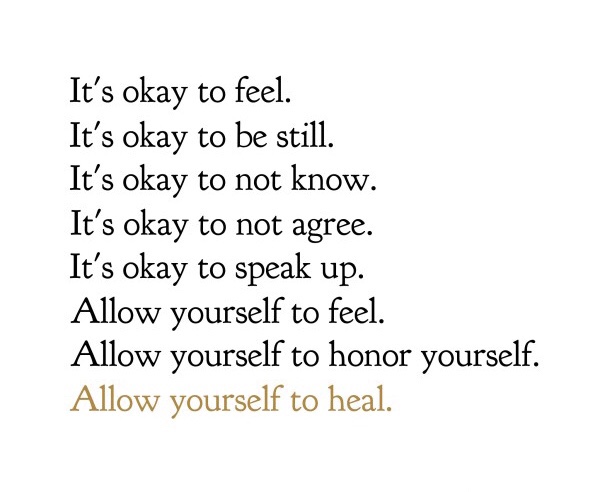
It’s okay..
It’s okay to feel. To feel is to be aware of you and your feelings. To be aware of what you need. To be aware of being in need of help and speaking up. I am very big on self awareness and breaking the silence and breaking the stigma around mental health. Everyone, everyone has mental health. It’s human. Sometimes we look from the inside out and we see such happiness surround ourselves but all we can feel is a deep hole, a wound that never seems to heal. We feel empty… and it’s perfectly okay to feel. But what we all need to understand is, it’s not okay to not heal that wound. Healing is more than possible, it’s closer than we think. Depression has a way of making us feel far away, way down below, when in reality, we never left the surface. Never feel ashamed of what you feel, never let yesterday become your today. Life is a journey full of experiences and lessons. It’s an amazing thing. If we do not fail or fall down sometimes, we would never learn to stand up taller than before. We would never be able to experience great happiness without knowing what it feels like to be emotionally down. I would never promote feeling bad. That’s not what I mean.. I mean that how would we know how great it is to feel that beautiful, warm summer morning, if we never felt the cold? It’s like a breath of fresh air, to go through change. So, sometimes that’s all we need is a breath of fresh air within ourselves, which would be the change. Changing the bad feelings into the positive, good feelings. I know personally how it feels to believe that change and/or happiness is not possible. I know the dreadful feeling of trying and failing and thinking that it will always be a never ending cycle. But what I also know is.. those feelings are not true. They are a part of the cycle of depression, so yes a cycle is right.. but not the hopelessness. Speaking out, speaking up for yourself is the very first step to healing. Finding that source of help whether it be talking to a professional, a friend, anyone you trust can make a huge difference. I remember trying multiple times to talk about my issues with depression/anxiety/ptsd in therapy and it seemed as if I was getting no where, which goes back to feeling of being stuck in that dark cycle… but always understand that it doesn’t always happen on the first try, don’t give up!because eventually we do find that perfect source of communication, a person we are comfortable sharing such vulnerable feelings with. Which then will lead to different strategies and tips to moving forward and managing your mental health. There are so many ways that you can get to that first step of healing… “feeling is not unhealthy, it’s when we ignore our feelings and/or feeling ashamed of being human, ashamed to ask for help”
Professional help list:
• Counseling (someone you are comfortable with)
• Support Groups (helps to see that you are never alone)
•Call 1-800-273-TALK (8255) to reach a 24-hour crisis center, text MHA to 741741
(Of course it is always best to seek professional help, though I know sometimes in an urgent time of need some like to have helpful tips for comfort) (in a crisis please always remember the help line posted above!)
Self Comfort options:
•Talk to a trusted friend/family member
•A hobby that makes you feel peaceful, happy, and gives self value
•Exercise (personally, I love going for a nice jog/run! I always end up feeling a huge difference in my mood after a good running session and some music!)
• Painting! (I am honestly not the best artist, at all. lol. But I really enjoy putting on some relaxing music, or sometimes no music at all, just me and my thoughts..depending on my mood, and getting out my paints and canvas and just painting away at how I feel, it honestly helps to put down in plain sight how you feel. It is an emotional release) emotional art is art. Maybe you’ll end up with quite an eye for what you paint and remember, the sky is the limit)
•Writing! (as said above, writing down how you feel is amazing! It’s like you are pouring all of the bad out into paper, into plain sight, but it’s no longer intensely within you, it’s now on the outside…I even tend to throw away what I write down after I’m done, as in to throw away all of those bad feelings, literally!)
•Get a pet. (If possible, a pet of your liking can be very comforting! I personally have 2 cats. And sometimes when I’m feeling a bit down or just want some relax time to re-group, a nice cuddle session with my fur babies help dramatically. The always love us for who we are. It’s like your own emotional service animal.
Now that we talked about some tips to help, how about going over the signs and warning signs that we may be struggling with an emotional/mental health issue.. because honestly, sometimes we don’t fully know or understand what we are going through. Signs of emotional distress:
•Long-lasting sadness or irritability
•Excessive fear, worry, or anxiety
•Extremely high and low moods
•Social withdrawal
•Dramatic changes in eating or sleeping habits
Of course these are just a few signs, but always stay self aware! Know when you may need to seek help or find that positive comfort in your life.
Looking over the list of signs and tips to get help are a way to understand what is normal for you personally and what is abnormal, and how those can be managed. Even if you are unsure, it never hurts to talk, to break the silence and get help understanding what may be going on with yourself emotionally. Maybe it’s just a bad day, an unlucky week, or maybe you are in face showing signs of depression, anxiety, or another type of emotional issue.
Always remember, we are worriers, and giving up is never an option! We all have a beautiful purpose in life.
Break the silence, break the stigma!✊💚
 Live to Inspire - Mental Health Awareness